Showing posts with label St. Anthony. Show all posts

Sunday, March 05, 2006

Thrive - Part 10


INT. CAFETERIA - DAY

Bill sits at a table by himself. He has a newspaper and a plate with scrambled eggs, toast and a slice of cantaloupe.

The headline of the newspaper says: "Hospital Director Resigns."

Bill looks down to his plate and picks up the cantaloupe. He takes a bite.
The headline of the newspaper now reads: "CDC: "Aluminum not responsible for memory loss."

Bill is holding a honeydew, there is a bite taken out of it. He takes another.
The headline of the newspaper says: "Bill Janus indicted in hospital scandal."

Bill puts down the paper and uses a knife and fork to cut his steak. Someone coughs behind him. He turns his head and June is standing at the kitchen sink washing dishes. She wipes the back of her hand on a dish towel.

Bill picks up the copy of Gray's Anatomy he has been reading. He looks at a picture of the liver.

Bill cuts the liver and onions on his plate. The sound of people clicking knives on water glasses makes him look over.

Janice sits next to him, she is wearing a wedding dress, he is wearing a tuxedo, he leans over and kisses her. He closes his eyes. When he opens them, he is kissing June, she is wearing a negligee.

Bill is in bed with June, he is wearing purple satin pajama bottoms. June is asleep. Bill gets out of bed and sits down on the floor Indian-style.

Bill plays with legos wearing purple flannel pajamas on the floor of the hospital room. A very old man sits on the bed watching him.

OLD MAN: Do you love me Solomon?
BILL: Is that my name?

Bill looks at the old man for a response. The old man looks confused, he is trying to find words to say.

OLD MAN: Well...um...ummm.

The left side of the screen starts to turn blue in an irregular moving patch. The patch consumes the old man and becomes a vaguely human shaped patch of blue.

BILL: Is that my name?
PATCH OF BLUE: Do you love me Bill?
BILL: Do you love me Solomon?

The patch of blue is now green.

PATCH OF GREEN: Kilimanjaro

Bill sits next to Solomon, everything else is white.

BILL AND SOLOMON: (simultaneously) It's hyphenated.

The patch is now a circle, the color shifts from blue to green and changes in diameter.

CIRCLE: Willy-um-Janus. Solly-mun-Janus

Solomon's face is very big. His lips don't move, his eyes blink rapidly.

SOLOMON: Butler-Janus. It's hyphenated.
CIRCLE: Solly-um-but-ler-willy-mun.

Bill and Solomon's heads are fused together at the back, Bill's face on the right, Solomon's on the left.

BILL AND SOLOMON: Janus.

Absolute Chaos. Several bits of the film overlapping each other, in increasing states of digital decay. Sounds from before, sometimes lines said by the wrong people, nothing disctinctly audible though. Everything progresses toward absolute white which is achieved about thirty seconds before absolute silence.
Credits come out of the white in a neutral gray and scroll to both sides of the frame from the center.

THE END

Friday, March 03, 2006

Thrive - Part 9


INT. BILL AND JUNE'S KITCHEN - DAY

JANUS: Happy Anniversary.
JUNE: What?
JANUS: Thirteen years right?
JUNE: Thirteen years?
JANUS: January 17th.
JUNE: Thirteen years since what, Bill?
JANUS: Since we've been married.
JUNE: Two years, Bill. Three next June.

Thursday, March 02, 2006

Thrive - Part 8


INT. JANICE AND BILL'S BEDROOM - DAY

Janice and Bill come into the bedroom, it's nine o'clock in the morning and they have just returned from staying up all night in the hospital. Janice goes to the closet and starts to undress. Bill stands in the doorway and looks at her.

JANUS: I can't do this anymore.
JANICE: I know how you feel. It seems impossible that this is happening.
JANUS: No, you don't. You don't know how I feel. This isn't an expression of frustration. I seriously cannot do this any more.
JANICE: What choice do we have?
JANUS: There are some people who are able to do things like this, there are people who can suffer through tragedy and feel like it makes them stronger. I'm not one of them.
JANICE: How do you know? How have you suffered before this?
JANUS: You, I think, are one of those people. You can be the hero in this, the patient one, the longsuffering one. I'm the villain here, I know it. I am designed to be the asshole.
JANICE: You need to go to sleep Bill, we have to go back in four hours.
JANUS: I am the weak one, the one to hate. The one that had to be lost. You can be the one who was somehow able to make it. The woman who's only son is in the hospital, who's husband left her, just when she needed him--
JANICE: What?
JANUS: Who's husband left when things started to look bad, he just dropped her, left everything there his son, his house, and found another life, another woman to live with.
JANICE: Stop it. Bill. Stop it.
JANUS: Who never saw him again.

Janice picks up a shoe from the ground and throws it at him.

JANICE: Quit it right now. How can you say those things?
JANUS: Who fought against him, begged him to stay but he wouldn't listen. When she held onto his feet when she punched him as hard as she could-- which is not very hard, she's a small woman--he pushed her away, he ran, he literally ran out the door, slammed the car door as she stood on the steps crying until she collapsed.
JANICE: Why are you doing this to me now. Stop. Please stop, I can't take this.
JANUS: You can. It's me who can't take it-- and he backed out of the driveway looking her in the eyes the whole time. You see he never had a soul, never really loved her, or his son, and he had to get out.
JANICE: Get out!

Wednesday, March 01, 2006

Thrive - Part 7

INT - JANICE'S KITCHEN - DAY

Bill and Janice are preparing food for Solomon's birthday party. Solomon, now fourteen years old is in the dining room, he has a basket of crayons in front of him. He is coloring pages in a coloring book. He draws overlapping squares of color, disregarding the lines on the pages..

Bill cuts beef and chicken into chunks for shish-kabobs, Janice is cutting the vegetables.

JANUS: It was two days late, they don't even charge a late fee for five.
JANICE: You think it's late fees I'm worried about? Bill, that was two days thinking that you had abandoned us, or that you had died, or worse.
JANUS: What's worse than that?
JANICE: There are things worse then death.
JANUS" Yeah, I've heard that before, but nobody can ever tell me what they are. I don't think there's anything worse than that. No matter how much you've accomplished…
JANICE: Don't try to change the subject.
JANUS: No, Janice, this is the problem, no matter how much you've planned and prepared, when you go, there will be something you never did, some part of being alive that you have never experienced. While you're alive there's at least the possibility that some day you'll do it, but when you're dead, you're nothing but a list of what you didn't do.
JANICE: (sarcastic) You know what, you're right, every time I think of Martin Luther King I think of all the things he didn't do.
JANUS: He doesn't think at all any more, he doesn't exist; everything we know about him is made up--what someone else thought about him. Even stuff he wrote down, we only know what it means based on what we think ourselves.

Tuesday, February 28, 2006

Thrive - Part 6


EXT. JANICE'S BACK DOOR - DAY
Bill tries to open the back door to Janice's house but it's locked. He picks up the doormat. Just dirt under there. He looks in the potted plants--nothing. He reaches up over the top of the door, there's the spare key.
He unlocks the door and puts the spare key back.

INT. JANICE'S HOUSE - DAY
Bill walks quietly and carefully through the kitchen into the living room.
The phone rings, startling him.

He walks straight back to a coffee table, opens the drawer. The drawer is full of junk, which he pushes aside, retrieves a photo album, messes the junk up and closes the drawer.

Bill locks the door from the inside before leaving.

EXT. JANICE'S NEIGHBORHOOD - DAY
Bill walks through the back yard, cuts through the neighbor's yards and walks around the corner to where his car is parked.

INT/EXT. BILL'S CAR - DAY
Bill sits in the driver's seat, the photo album is on the seat next to him. He looks at it sitting there. He looks back in the direction of Janice's house. He picks the photo album up.

EXT. JANICE'S NEIGHBORHOOD - DAY
Bill goes back through the neighbor's backyard, this time a little girl is playing in the sand box. He ignores her and goes through to Janice's yard. The little girl runs into her house.

EXT. JANICE'S BACK YARD - DAY
Bill reaches up and gets the spare key to the back door again.

INT/EXT. JANICE'S CAR - DAY
Janice is driving, talking on her cell phone with a hands-free device.

JANICE: I'll be there soon, call me at home.

INT. JANICE'S HOUSE - DAY

Bill walks through the kitchen quickly and into the living room. He opens the drawer. He hears a car pull into the driveway.

JANUS: Fuck.

He puts the photo album back into the drawer, closes it.

He runs back through the kitchen to the back door.

He opens the back door. Janice is standing with a bag of groceries looking through her keys.

JANICE: Bill.

Monday, February 27, 2006

Thrive - Part 5


INT. BILL AND JANICE'S KITCHEN - DAY

Bill winces in expectation
Janice squeezes his fingertip, a drop of blood bulges and starts to run. Janice catches the blood on a blood sugar test strip.
They wait in silence. The blood sugar test machine beeps. Janice looks down.

JANICE: (pleading) Bill.
JANUS: I’m sorry.
JANICE: Drink some water and walk around the block.
JANUS: I know.
JANICE: You’re like a little kid sometimes.

INT. SOLOMON'S BEDROOM - NIGHT
Solomon lies on his back on the top bunk of a sturdy white bunk bed. He stares at the ceiling. His breathing is heavy. He rocks his knee back and forth nervously with increasing speed. Soon he is breathing faster and faster to the point of hyperventilating. Janice approaches the bed.

SOLOMON: I think I'm going crazy.
JANICE: Go take a hot bath.

INT. BATHROOM - NIGHT
Bill sits in a bathtub. Condensation drips from the mirror. June paces back and forth outside the door with a cordless phone to her ear.

JUNE: I don’t know...an hour ago?

Junes disappears. Bill gets out of the tub, dripping. He dries himself off.

JUNE: At his age?

Bill closes the bathroom door, and turns the lock.

Sunday, February 26, 2006

Thrive - Part 4


INT. BILL AND JUNE'S BEDROOM - NIGHT

Bill is undressing down to his boxers. June is brushing her teeth. She spits.

JUNE: I love you Bill.
JANUS: I know June. I always know you do.
JUNE: Bill. He loves you too. Don’t worry.
JANUS: That’s what everyone says. That’s what Janice said.
JUNE: Janice was there?
JANUS: No. On the phone. Don’t worry.
JUNE: I don’t.

Saturday, February 25, 2006

Thrive - Part 3


INT. SOLOMON'S HOSPITAL ROOM - NIGHT

The chart on the bed reads "BUTLER-JANUS, SOLOMON TOBIAS"
Janus sits on Solomon's hospital bed, a cell phone to his ear. Solomon has emptied the bucket of all of the Legos.

JANUS: Janice Butler please.

During the pause, Solomon removes Legos from a small area of the floor and puts them back into the bucket. He curls up in the empty space.

JANICE: (on phone) Hello?
JANUS: It’s Bill. I’m at the hospital.
JANICE: Where in the hospital?
JANUS: In his room. They let me in.
JANICE: When?
JANUS: A few minutes ago.
JANICE: How is he?
JANUS: He hasn’t responded to me yet.
JANICE: You have to ask him direct question.
JANUS: I...I know that. I just wanted to watch him first.
JANICE: You should talk to him. He loves you.
JANUS: I just wanted to call you first.
JANICE: Don’t worry Bill, he won’t break.
JANUS: I wanted to let you know I was here, in case...so you would understand if he mentioned me or something.
JANICE: They would have told me. They keep a record.
JANUS: You’re right. I’m sorry. Sorry to bother you.
JANICE: No, it’s Ok. I understand. Don’t worry about him, just talk to him.
JANUS: I...I will. Thanks.

He hangs over and looks at the boy who is still curled up, his eyes are very wide open.

JANUS: Solomon?

No response.

JANUS: What are you making Solomon?
SOLOMON: The blocks fit together.
JANUS: That looks like a dog...Is that a dog?
SOLOMON: No. It’s blocks.
JANUS: Do you love me Solomon?

Friday, February 24, 2006

Thrive - Part 2


INT. KITCHEN - DAY
Bill Janus sits at his mother's kitchen table with his mother.

MOTHER: Why ‘Solomon?’
JANUS: After Janice’s Uncle.
MOTHER: Why’s he so great?
JANUS: He died as a baby.
MOTHER: You’ve named your first child after a failure to thrive.
JANUS: A second chance to thrive.
MOTHER: Solomon Janus...Solomonjanus...Kilimanjaro.
JANUS: Simon Butler-Janus.
MOTHER: Mother’s maiden name as a middle name. Just like you.
JANUS: Butler-Janus. It’s hyphenated. His middle name is Tobias.

Thursday, February 23, 2006

Thrive - Part 1


INT. WAITING ROOM - NIGHT

BILL JANUS sits on a waiting room bench in a hospital. He stares into the camera, his eyes questioning the audience from the very beginning. Why are they watching him at a time like this? Why is there a time like this? He is staring like he knows that he has been created to suffer for the entertainment of strangers. He pauses in total resignation to whatever evil has caused him to exist, and then is overcome by the idea that he was placed here to suffer so that others may suffer less.

A voice comes from behind him.

NURSE: Mr. Janus.

Janus holds his stare for a second longer, then looks over his shoulder slightly bewildered. A nurse stands over him. There is no one else in the waiting room.

JANUS: Yes?
NURSE: I will take you in.

Janus stands up and takes a step toward her, remembers his bag, steps back and retrieves it. Looks up at the nurse realizing that she is taller than he is.

JANUS: Ok.

The nurse leaves the waiting room through a door and Janus follows. They walk through a long hospital corridor, in the first rooms the oldest people Bill has ever seen are sitting up in beds, they are connected to respirators and intravenous tubes. They are as brittle as dead spiders. Janus and the nurse turn a corner, now rooms contain retirement aged men and women eaten by cancers, drowning from congestive heart failure. They turn again and pass middle aged people, wheezing because their lungs do not work or yellow with kidney failure. The next turn leads to young adults, accident victims, blood-stained sheets. The final turn leads to children: leukemia, birth defects. The nurse stops in front of a doorway.

NURSE: In here.

Janus nods at her and enters. His seven-year-old son, SOLOMON, sits on the rough grey carpeting. He is taking legos out of a bucket. He sticks two or three together and sets them onto the floor, then gets a few more, sticks them together and puts them somewhere else. He is already surrounded by a patternless mess of different-sized Lego clusters.

JANUS: Solomon.

The boy looks up at his father.

Tuesday, February 07, 2006

St. Anthony and the Key Chain - Part 5


He had never been the only person in a train car before. He noticed that the ride was bumpier when the train was not packed with a rush hour crowd. The rhythmic rocking of the train made it easy for him to think about nothing. Thinking about nothing was not worrying. He was not worrying if moving to the city by himself had been a mistake. He was not worrying about getting mugged on the walk between the train stop and his apartment. Most importantly, he was not worrying about what would happen when he got back to his apartment at two o'clock in the morning with no keys.

Only when the train had reached the end of its line, far beyond his stop, did he become aware again. Stoic, he crossed the platform, and, even though he knew it would be at least twenty minutes, he waited patiently for a train in the opposite direction.

A few minutes of waiting in the silence with nothing to distract him, and he was back to the worrying that had perforated his entire day. It started with the memory of a feeling. He was there again, standing in the chilly foyer, waiting for the superintendent to let him in. That was the most humiliating part of the memory. Worse than the image of her in a dirty lavender bathrobe pressing her lips together in general disapproval of his existence. Worse than remembering that she had made him wait outside her door as she looked for her copy of his lease. Even worse than when she made him read aloud the section that said the superintendent had the right to charge ten dollars if a tenant had to be let into the building. It was always the moment between ringing the doorbell and her appearing around the corner that paralyzed him. He knew that she must hate him. He was sure she complained to her friends about the stupid kid who moved in upstairs. The stupid farm kid who locked himself out four times in three weeks and does not belong in the city.

When he came out of it, he was angry at himself. He had to try harder not to think about it. He reminded himself that it was throwing all of his belongings into his car and moving to the city was an accomplishment. He had adapted to working in the main branch of the bank, almost without problems. It did not matter that he did not know anyone here. He was where he had always wanted to be. He had his own apartment, right above the superintendent, who by now was sound asleep.

He knew he should have just gone home right after work. At least then he wouldn't have to wake her up; but he couldn't do it. When people started leaving the office to go home, his mind kept going back to the night before. Midnight, and she was standing outside his door, still in the lavender robe. She was screaming. He was sorry, he said. He hadn't realized she could hear him. She just screamed.

When he got hungry, he went alone to a restaurant and pretended to read a newspaper while he ate. At the movies, he tried to act as though he was waiting for someone, looking at his watch every minute and sighing when the previews began. After the movies, he went to the bar alone. He sat at a table in the corner, listened to other people talking and only once thought about how pathetic it was to be afraid. He was also alone, or nearly so, on the platform, and by now it was very late.

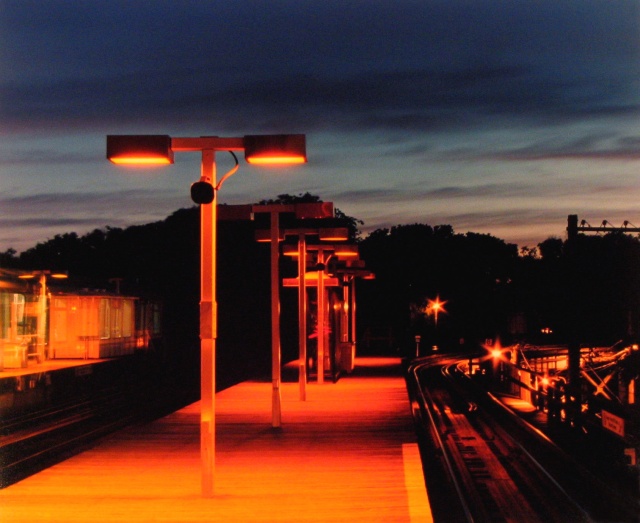
From the elevated platform, he could see far down the street, wet and reflective of the ambers, reds and yellows of a city at night. The wind blew gently but steadily, blowing through the spaces between his skin and his clothes, taking heat and anxiety with it.

It was quiet enough that he heard the train coming before he could see it. He watched almost like an animal, as the light spilled down the tracks followed by the train itself, slithering.

This train car was empty as well. He took a seat in the middle, set down his bag, and leaned his elbow against the cold glass. He watched the city move past the window in a sleepy fog of taillights, traffic lights, neon lights.

At the next stop, he watched with his peripheral vision as a old woman stepped into the car and chose a seat across the aisle. She was a black woman, grandmotherly and tired. She sat in a seat that faced the back of the train; riding backwards made him queasy. He wondered where she was coming from so late at night and where she was going. Every possibility he could think of seemed wrong. She was impossible to know.

He looked out of the window again, now pressing his forehead against the glass. As the train began to move again, his face slid down the window, and he did nothing to stop it until his chin touched the rubber seal at the bottom. That is when he noticed the paper square on the seat next to him. He recognized it even before his eyes had focused. It was the prize from a box of Crackerjacks.

He rubbed the small package between his fingers, held it up to the fluorescent lights, and wondered what kind of person would buy Crackerjacks and not care about the surprise. He tore open the paper and smiled when he saw that it was the temporary tattoo. Using his free hand to unbutton the stiff white cuff of his shirt, he rolled the blue-striped sleeve up to his armpit. He peeled the paper backing off of the tattoo and licked his left biceps impishly before pressing the thin paper onto the moist skin. He counted out thirty seconds in his head and then lifted the damp square.

He smiled at the reflection in the window as he flexed his arm; he smiled wider when he saw the heart-with-arrow stretch as his muscles changed shape. He stopped smiling when he noticed the woman across the aisle staring at him.

Embarrassed, he unrolled his sleeve and looked down at his feet. He was buttoning his cuff again when he saw something that made his eyebrows squeeze together. There, under the seat in front of him, were his missing keys.

It is hard to interpret just what this meant. For some people, ending up in the exact seat of the exact car on the exact train would be proof of the existence of God. Most others would at least experience some awe at having the law of probability demonstrated so eloquently in their favors. But this young man was not thinking about the universe. It was almost as if he had expected it. When the keys were lost, he had still been almost certain, unless they had been melted or broken or disintegrated, that the key chain had to be somewhere. That knowledge that the keys still existed turned into a small bit of hope and had always found hope to be worthwhile. Any feelings about the matter however, were overshadowed by something less complicated: he was relieved to avoid the superintendent. He returned the keys to the front pocket of his pants before turning sideways in his seat.

"I just found my keys," he said. The woman, who had been close to sleep, turned her eyes but said nothing. "I lost them this morning. They must have fallen out of my pocket. All day I worry about how I'm going to get back into my apartment, and then I look down and there they are. I must be on the same train that I took this morning. Only it can't be the same train; the seats were different. But they were right there, on the floor." When he stopped speaking, the woman looked down at her hands, paused, and then looked back up at the man.

"It's hard to believe," she said.

"Yes," he replied. "It is hard to believe, isn't it?" They were interrupted by the recorded voice announcing the next stop. He stood and kept his balance by holding onto the bar above the seat. "You be careful out there," he said, and she nodded. He walked along the decelerating train car, the bars steadying him until he made it to the doors. When the train stopped, the doors opened and the wind spilled inside.

"Doors closing," said the voice. The man patted his front pocket, heard the faint sound of metal rubbing against metal, and then stepped off of the train.

Thursday, January 26, 2006

St. Anthony and the Keys - Part 4

She slid the key chain across the scanner, just like she had done with tens of thousands of groceries, coupons and key chains before. The motion sensor turned on the laser. The laser was absorbed by the thin black lines and reflected by the white plastic between them. The computer translated that pulse into a number that, in turn, it translated into an address in a database. Ten kilobytes of information traveled just less than six miles at three hundred million meters per second and, upon arrival produced the brief high-pitched beep that still satisfied her each time she heard it.

She switched off the light at her station before picking up the phone and dialing the number at the top of the screen. A very tired woman answered. It was the emergency number of a veterinary hospital. The number must have been changed or faked. She checked the name again and realized that it was fake too. Sandy Klaus. The address section said just "North Pole". He or she must have applied for the card around Christmas time.

This fascinated her. Who would be so paranoid as to give a fake name to the grocery store? Had the store been busier she would have thrown away the keys right there, but she was curious and so she went deeper into the customer’s record.

In a few seconds, she was analyzing a list of all the groceries the customer had bought over the last two years. Having been a check-out girl since high school, she thought she could tell a lot about a person by the groceries he or she bought.

She knew it was a man by his brand of shaving cream. Always the same kind too, even when it was not on sale. He was not as loyal to his deodorant, however. He bought whatever was new or improved.

Further in, she noticed that he had recently moved to the city. Up until one month ago, he shopped at a grocery store on the other side of the state; the country, she thought. She began to create a picture of him in her mind.
He was alone in the city, shy probably. He was single; she was sure of it. Half gallons of milk always gave that away. But he could cook. He bought a lot of spices and oils and strange produce like leeks and artichokes. He ate meat but in moderation. He bought steaks and lamb chops, but no pork. He took vitamins.

On Friday nights, he often bought a slab of fancy cheese and a bottle of wine. But he had not done so in the last two months. She imagined him showing up at her door, setting the bottle on the kitchen counter while she set the table with a plate for the cheese and two wine glasses.

She continued to imagine him long after she was finished looking at his record. She gave him a name and a college degree, tropical fish and a newspaper to read in the mornings and before bed. She gave him a face. She made him a little funny looking but with beautiful dark eyes. She stared at him in her mind and thought she felt a bit warmer inside.

She imagined him waking up in the morning in blue and white striped pajamas. As she balanced her drawer, he was shaving off the moustache she had told him she didn’t like. She rang up one last figure, added a crinkled dollar bill to her drawer before locking it, and picked up a box of Crackerjacks for the ride home.

She put the key chain into her purse when she left, pretending he had given her the spare keys to his apartment. She played with the keys on her lap during the ride home. She imagined him getting onto the train and sitting next to her. He would see the keys out of the corner of his eye and ask her how she got them. She would tell him, and, full of surprise and gratitude, he would ask to buy her coffee, and that is where it ended.

Her stop had arrived. Through the window she could see a man standing on the platform. He was looking at a train schedule and she thought he looked troubled or confused. He had a moustache. She approached him as she stepped off of the train.

“Are you lost?”

Sunday, January 15, 2006

St. Anthony and the Keys - Part 3

The beer cans were moving toward him. He chuckled. The beer comes to me all by itself, how can I resist? The six-pack stopped moving when it reached the end of the conveyor belt. He looked at it and wondered if the check-out girl had a foot pedal or something that made the conveyor belt stop. At the end of the thought, he realized that the beer had been sitting still a lot longer than usual. Normally, a pair of hands would have appeared and lifted the six-pack out of view, but these cans just sat there, static, looking happy to be plastic-bound into a little family of six. He looked up and met the expectant eyes of the cashier.
"What?" he said. "Believe me. I’m old enough to buy those."
"I’m sure you are," she replied. "Do you have a fresh values card?"

He had not expected this. His hands explored the pockets of his jacket and found the key chain his wife had given him. He tried to think of a way to explain everything to the girl, but she had already snatched the keys from his hand. She ran the keys over the gadget at the end of the conveyor belt, and something beeped. He took the keys back, deciding it was better to just pretend they were his.

She picked up the six-pack and turned it over to find the barcode. He did not like the way she was looking at the beer. When did it become wrong for a forty-eight year old man to like beer? The thing that beeps, beeped once more, telling him it was time to pay.

"You kind of look like my wife, but younger," he said, setting a wad of bills and change on the platform. She did not react; she just counted the money, twice, and then held crinkliest of the bills over the little platform.

"It’s a dollar," he said. "It might be wrinkled but it’s worth the same as the others." She gave him a look that made him feel old.

"They’re on sale," she said. He was not sure if was smiling. "One dollar off ‘cause you used your card."

"Oh," he replied, looking at the green paper like it was a writhing wasp. "Why don’t you keep it?" She put the dollar into the pocket of her apron, and he left.

It felt good to pull the can from its plastic choke-chain. It felt even better to crack the seal and to hear the bubbles popping as the gas escaped. He drank it slowly, just like he did every Friday, thankful that his wife had insisted on getting the minivan with the tinted windows. Then, before he felt he had even tasted it, the can was empty.

The five full cans swung back and forth limply when he picked them up by the empty ring. He put them back into the paper bag along with the empty and scrunched it shut. He went over, as always, to leave the leftovers in the empty shopping cart, but a car full of teenagers had pulled into the spot next him. Their windows were rolled down and the kids were singing along enthusiastically to a song that he had once owned as a forty-five. He threw the cans in the dumpster.

On the way back to the van, he felt the intrusive weight of an extra set of keys in his pocket. He changed course and walked back into the grocery store, reliving the time he had lost his keys and sprained his ankle trying to break into the house.

"My wife found these on the train," he said, passing the key chain over the platform for the second time that evening. For the second time the girl snatched the keys, but didn't say anything. She didn't notice him slipping the pack of gum into his pocket either.

Friday, January 06, 2006

St. Anthony and the Keys - Part 2

She was sitting on something, and she did not know what it was. This was precisely the type of thing that she hated about taking the trains. Next time, she advised herself, she would use this experience as an argument when her husband was too busy to give her a ride down to the church. The idea of having an unfamiliar object pressed into her bottom was unsettling, but she could not stand up now; not with so many people on the train. Someone could sneak up and steal her seat, and then she would be stuck standing next to God knows what unpleasantness.

She tried to determine the shape of the object using her sense of touch, but there was too much flesh getting in the way. It was best to try and think of something else.

The train at rush hour should have provided enough distractions, but she could not find a place on which to fix her gaze. If she looked straight ahead, she would be looking at that young man’s crotch; down and she had to stare at the garbage on the floor. To her right, someone had written a swear word on the window, and to the left, well, she did not like the look of that man.

She remembered reading about a young woman who contracted AIDS from a hypodermic needle that someone had left in a vending machine. Whatever it was she was sitting on she was sure that it was sharp.

Her mind wandered from there. Around the time she was imagining the color of the lining of her casket, the train wobbled out of the subway tunnel, and her weight pushed the mysterious object deeper into her substantial thigh. Startled, she stood up.

The back of her thigh was hurt--that she was sure of--but she could not quite tell if it was serious. She was still too afraid to look, and, now that she was standing, she had no free hand to feel the wound. One hand was squeezing the pole, and the other hand was keeping her purse close to her kidneys. Next time she would take a taxi; she would even use her own money if necessary.

A black man, an old black man, squeezed his way through the crowd at the doors and grabbed on to the pole across from hers. She looked at him and thought maybe she should smile, but she was worried about her leg; to smile would be like lying. She turned her head away.

There were so many people on the train, girls with too much makeup, children who needed bathing, that rude man on his cell phone. A beer bottle rolled from under one of the front seats and smacked against a partition before rolling back. Maybe she had sat on a piece of glass. The man with the phone might be a doctor; she could turn, and he would notice if her leg was bleeding; maybe he had some antiseptic in that briefcase. A little bit of antiseptic would keep the germs out until she could get off of the train. She hoped that she would not have to go to the hospital.

The black man was looking at her. She looked at his wrinkled clothes. He was probably homeless. She looked at his eyes looking at her; even the whites of his eyes seemed to have some brown to them. He slid his eyes deliberately, pointing with them to the empty seat and then back up to her face. What did he see? Was he trying to warn her about something? No. His expression was tired and pleading. Maybe he wanted his needle back. She squeezed her purse more tightly and tried to look stern.

The pain in her leg was almost gone, she decided. The object, whatever it was, had most likely not broken the skin. Still, it was best to be safe. Besides she was so tired of standing. She rearranged her hands on the pole and looked over her shoulder. There was something there but it was not glass or a needle. It was not even all that sharp, just an ordinary looking set of keys. She could not imagine anyone getting sick from a set of keys and so she picked them up and reclaimed her seat.

She put the keys into the crevice between her legs and consulted the map above the door. There were still thirteen stops left, and so she passed the time by looking at each key and trying to guess what it opened. Most of the keys were ordinary, but one small key stood out; it looked like the key to the liquor cabinet where she now kept christmas decorations. Along with the keys there was a plastic bottle opener that advertised Southern Comfort. The name brought on memories of nausea and she let it fall.

The last thing on the key chain was a small plastic tab with a picture of a tomato and the name of a grocery store chain. There was one just like it on the key chain in her purse. Her fingers slid across the raised ink as she read the tiny print on the back:

"If found, drop into any mail box. Postage guaranteed."

She dropped them into her purse instead.

Monday, January 02, 2006

St.Anthony and the Keys - Part 1

"Doors Closing." The words echoed through the subway tunnel, but no one was listening. A compressed knot of people squeezed between the sliding doors and, hitting the cool underground air, exploded into a swarm. The human cloud wafted up the escalators and through the streets to settle into offices and to begin the day's work. But they had left one man behind. He stood stiffly, his back to the departing train, patting his pockets in a slow panic. Wallet, change, lighter, cigarettes. Receipt, change, lighter, cigarettes. No keys. He turned and watched the red eyes of the train disappear into the black subway tunnel.